Week 13: Greece's Economic Crisis Still Hurts
Greece’s Bailout Is Ending. The Pain Is Far From Over.
Summary: Greece has been in an economic crisis over the past decade, and it is finally over. During the crisis, a third of the population was in poverty, and the rest experienced pay-cuts. Most Greeks cannot even afford to pay for their rent or their electrical bills. On top of that, Greece relied on about $360 billion on bailouts to help them escape the crisis. Even though unemployment in Greece has decreased since the end of the crisis, it is still the highest in the eurozone.

This shows a day center in Athens. Day centers serve as places for homeless people, refugees, and troubled Greek families to do their laundry, shower, and seek medical aid.
Luckily, due to Greece’s variety of tourist destinations, such as islands and historical landmarks (like the acropolis), small businesses are beginning to thrive, and larger ones to rebound. There are also social aspects of the crisis that still linger after its end. For example, many people are left depressed, and suicide rates over the crisis had steeply risen. Although those rates have diminished, they are still much higher than what they used to be before the crisis. Debts caused by the crisis also led to many divorces and breaks in familial ties. At the moment, the crisis still prevents Greeks from much if any more than the bare minimum they need to survive.
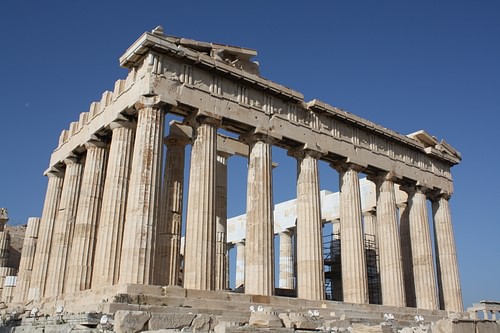
The Parthenon (which is part of the acropolis in Athens) serves as one of the many tourist destinations in Greece that has provided economic support to the country, and has helped Greece to become more like how it was before the economic crisis.
Reaction: I feel bad for the people in Greece who are taking a heavy toll due to the debt crisis. It’s saddening to see so many people below the poverty line, and to imagine what life must be like over there. However, I am hopeful for the country as business begins to rise. The bailouts and aid from other countries helped the Greeks get back to a more normal state of life. The world should take this as an example of what human kindness is and to apply it to other impoverished countries.
Connection: This relates to the Weimar Republic that formed after World War I in Germany. They experienced an economic crisis after needing to pay off their war debts. Although the two crisis of each country arose from different issues, they both led to similar results. In both cases, many people fell below the poverty line, and in both cases, the issues continued after the crisis. Unsettlement and unhappiness due to low quality of life was experienced after both situations (and still is being experienced in Greece). For example, in the Weimar Republic, people burned their money due to inflation to get warmth. In the same sense, Greeks under the poverty line can not afford to pay their electrical bills, and thus live without electricity (and in the cold).
Questions to consider:
1) Do you think it is safe to say that Greece's economic crisis is over, considering the fact so many people are still barely able to live?
2) For any country in an economic crisis, when is increasing taxes too much, or when is it time to seek international economic support, such as Greece did with bailouts?
3) What are some methods Greece could use to gain income and restore a good quality of life?