Blog Assignment

Friday, March 8, 2019

WEEK 8: Tensions escalate between Pakistan and India Crisis

Tensions escalate between Pakistan and India Crisis 

Image result for india and pakistan nuclear war
The global cost of a nuclear war between India and Pakistan 

Summary: 
Last week, tensions escalated between India and Pakistan. This began when both countries shot each other's fighter jets down. There has always been a history of conflict between the countries, especially after 1947 when Pakistan split off from India. India and Pakistan fought three conventional wars varying in 1947,1965 and 1971 before getting nuclear weapons.  Many wars followed, most recently in 1999 along the Kashmir mountainous region. The conflict has encouraged both countries to strengthen their military; however, India currently holds a higher place in terms of military material, personal and money. Due to India being more economically stable, they are considering developing forces to attack Pakistan's nuclear weapons.  

India and Pakistan continue to increase nuclear weapons. 

Although India has more advanced material, Pakistan has a network of canals still in place from WWI, which make it harder for Indian formations to enter Pakistan. 

Indian politician and advocate, Arun Jaitley tweets about the economic tensions. 

For the first time since 1971, India bombed mainland Pakistan. This occurred due to a Pakistan terrorist group supporting a suicide bombing that killed about 40 Indian paramilitary soldiers in the Kashmir Territory. 
Both countries have strong nuclear power. Pakistan wants Indian to realize a nuclear threat is there and that they can always use terrorist groups against, and both discourage India to retaliate.  


Reaction:  
Both opposing sides are using nuclear weapons as a threat. In the long run, it can result in fighting and conflict. Both sides are using violent tactics, therefore can kill millions. People are getting injured and killed everyday. Fighting violence with violence won't solve any of the two countries future problems.    


Connections: 
This topic connects to our current unit about the Cold War. Both sides are aiming to use nuclear threats to intimidate the opposing side, similarly to how the USSR and the US used nuclear threat in the Cold War. Even though neither side used their nuclear weapons, both sides feared nuclear war which discouraged extreme actions. While it's true that the fear of nuclear escalation may reduce fighting, nuclear weapons would result in severe danger. This makes neither side want to take any drastic measures in fear of nuclear attack on their country. 


Questions:  
1. What are the potential consequences of India bombing mainland Pakistan? 
2. How might this conflict be affecting surrounding countries?
3. What are some ways this conflict can be resolved? 

Additional Sources: 
https://www.cnbc.com/2019/03/01/india-pakistan-conflict-timeline.html 
    

Thursday, March 7, 2019

WEEK 8: The Cases Against Netanyahu and a Decision to Indict


On Thursday, February 28, 2019, Israeli Attorney General Avichai Mandelblit announced his plan to indict Prime Minister Benjamin Netanyahu for bribery, fraud, and breach of trust. PM Netanyahu denies any wrongdoing and believes that he is being persecuted by the country's left wing. Before he can be formally indicted, he is entitled to a hearing. If he is tried, he would be the first sitting Prime Minister in Israel to face prosecution. 


Packer (L) and Milchan may be considered witnesses in Netanyahu's hearing. 

Illegal Gifts Affair (also known as Case 1000)
In the past, Hollywood producer Arnon Milchan, in partnership with Australian billionaire James Packer, delivered expensive gifts of cigars, jewelry, and pink champagne to Netanyahu's official Jerusalem residence. The price of the bribes totaled more than 280,000 US dollars. In return, Netanyahu encouraged the extension of a ten year tax exemption to expatriate Israelis returning to the country and helped Milchan receive a US work visa. The Finance Ministry blocked the legislations, saying that it "was against the national interest." If the legislation was passed, it would have financially benefitted Milchan. 

Recently, Mandelblit announced that he would not press charges on Milchan, despite his central role in the alleged case of corruption. Netanyahu denies the allegations, and both billionaires say their gifts were not intended as bribes. Mandelblit decided that Netanyahu should be charged with fraud and breach of trust for his involvement with the gifts.

Case 2000
In addition to Case 1000, Netanyahu was also accused of exploiting his relationship with US casino owner Sheldon Adelson to curb unfavorable media coverage of his government. An agreement was alleged negotiated with Arnon Mozes, publisher of Yedioth Ahronoth, a major Israeli daily newspaper over the phone. In the alleged deal, Mozes would ease off of his paper's critical coverage of Netanyahu in exchange for the Israeli Prime Minister pushing Adelson to limit the circulation of the Israel Hayom - a free American newspaper who rivals Yedioth Ahronoth. Although the deal was discussed over the phone, with details recorded by Ari Harow, the PM's former chief of staff, it was never consummated. Netanyahu claims the deal was a joke. Adelson says he was never aware of any alleged deal between the Israeli PM and Moses and is angered by the idea. Netanyahu is to be charged with fraud and breach of trust. Mozes is to be charged with bribery. 

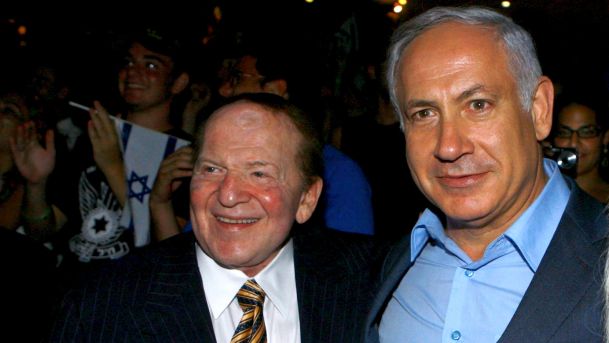
 US billionaire Sheldon Adelson (L) and Netanyahu
Case 4000

From 2014-2017, Netanyahu served as communications minister, in addition to prime minister. Shaul Elovitch, was a former chairman and shareholder of the Bezeq group, parent company to Walla, one of Israel's leading news sites. He is also a close friend of Netanyahu and has been accused of ordering Walla to provide more favorable coverage of the Netanyahu family. Mr. Netanyahu is accused of offering favors to the news company in exchange for better coverage, especially during the 2013 and 2015 elections. Walla surpressed and softened critical reports of Mr. and Mrs. Netanyahu, covered up stories with flattering pictures, and met many of the couple's demands. Netanyahu is to be charged with bribery, fraud, and breach of trust. Mr. Elovitch may face prosecution for bribery, obstruction of justice, money laundering and security violations. Despite Mrs. Netanyahu being heavily involved with the demands given to Walla, there is "insufficient evidence" that she understood the official action being returned, so she will not be charged, although the state attorney still believes Mrs. Netanyahu should be charged with bribery. 

If Netanyahu wins the upcoming Israeli elections on April 9th, he will be the longest serving prime minister in Israeli history.

Additional sources:
1. Variety
2. Washington Post


Reaction:
I think that the current situation shows the lack of stability in the Israeli government. Just like in the US, there is a strong presence of "fake news" or bias reports that can easily change the public viewpoint on a country's leader. If the attorney general is indicting the prime minister, there must be other secrets that are being kept from the public. Given the alleged crimes Netanyahu is being tried for, I think he should step down from the upcoming election given the political unrest surrounding him right now.

Connection:
This topic connects to our current unit about the Arab-Israeli conflict. Depending on how the situation resolves, the way Israel handles the conflict may change. If Mr. Netanyahu losses the upcoming election, Israel's government may become more or less willing to compromise, possibly leading to a more peaceful state in the Middle East. If Israel elects a new prime minister, the country may become more unstable and susceptible to attacks by enemy countries.

Questions:

1. Do you think the grounds on which Netanyahu are being indicted on are fair?

2. Given Netanyahu's positive relations with Trump, do you think the US will be involved with the cases or support a side?

3. If you were in Trump's position, would you choose to support PM Netanyahu or AG Mandelblit?


WEEK 8: US Dept. of Transportation cancels nearly $1 billion grant for California's high-speed rail project

"US Dept. of Transportation cancels nearly $1 billion grant for California's high speed rail project"
Original Article, CNN source


Summary:
 In his first State of the State Address on February 12, 2019, Governor Gavin Newsom of California declared that the state's high speed rail project would "cost too much" and "take too long." Governor Newsom thus ends the plan to build a high speed railroad across the state connecting San Francisco and Los Angeles, which was introduced by Jerry Brown as the previous governor.

State of the State Address TIME Clip


The project's total initial funding of $3.5 billion came from two sources: the American Recovery and Reinvestment Act of 2009 which provided $2.553 billion and the Consolidated Appropriations Act which provided $929 million. President Donald Trump aims to collect back all the funding. The US Department of Transportation announced on February 19 that the $929 million federal grant to the California High-Speed Rail Authority has been cancelled.

However, the $2.553 billion grant is under agreements, making it harder for the Trump Administration to get the funding returned. California has no obligation to return the $2.553 billion, but the Administration continues to fight for it legally, declaring how the project has not met its expectations and thus is not entitled to the grant.

In response to President Trump's tweet criticizing the project as a "disaster" and demanding back the funding, Governor Newsom declares that he will fight to keep the money. Governor Newsom also claims that California will build high speed rail, but only focusing on connecting areas of the Central Valley. He sees Trump's motive of attacking the rail project is to find more funding for the wall on the southern American border and in response to California leading a lawsuit against President Trump for declaring a national emergency on the border.

Reaction: 
The conflict over the funding of the high speed rail seems to be a result of a polarization in domestic politics. Democrats are unwilling to compromise with the Republicans and both sides work against each others' policies.

Connection:
The desire for high speed rail in California to better transport goods and people connects to the use of railroads for mobilization during WWII and the Silk Road. During WWII, the need for the construction of railroads gave civilians jobs and mobilized the home front. The completed railroads were used for the mobilization of armies as trains transported troops and their supplies to and from battles. For the same purpose of building high speed rail in California, the Silk Road was created to better connect economic centers throughout Asia and facilitate the transport of goods and technology.


Discussion questions:
  1. Is Trump justified in wanting to get back the funding from the cancelled high speed rail road project? Why or why not?
  2. Is Newsom's decision to stop the construction of the high speed rail in California justified? Why or why not?
  3. What is the main obstacle of building high speed railway systems? Is it the cost, or is it something else?

Friday, March 1, 2019

WEEK 7: Trump-Kim Summit Updates: ‘Sometimes You Have to Walk,’ Trump Says as Talks Collapse

Link To Original Article Here

          Current United States president, Donald Trump, and North Korean leader, Kim Jong Un, are meeting this week to discuss denuclearization of North Korea as well as the U.S placed sanctions on North Korea. On Thursday, the day started in hopes of a denuclearization deal alongside an official declaration of the end of the Korean War. However, earlier than expected, the day of meetings and talks ended with no deal being made. Specifically, what was discussed in the dealings was the exchange of the removal of all US imposed sanctions for the deconstruction of Yongbyon, the heart of North Korea's nuclear programme. This is, however, not all of their facilities in the programme and so the U.S was not ready to give up so much for only partial denuclearization. In response to the failure of the meetings, President Trump stated at a later news conference, “Sometimes you have to walk.”


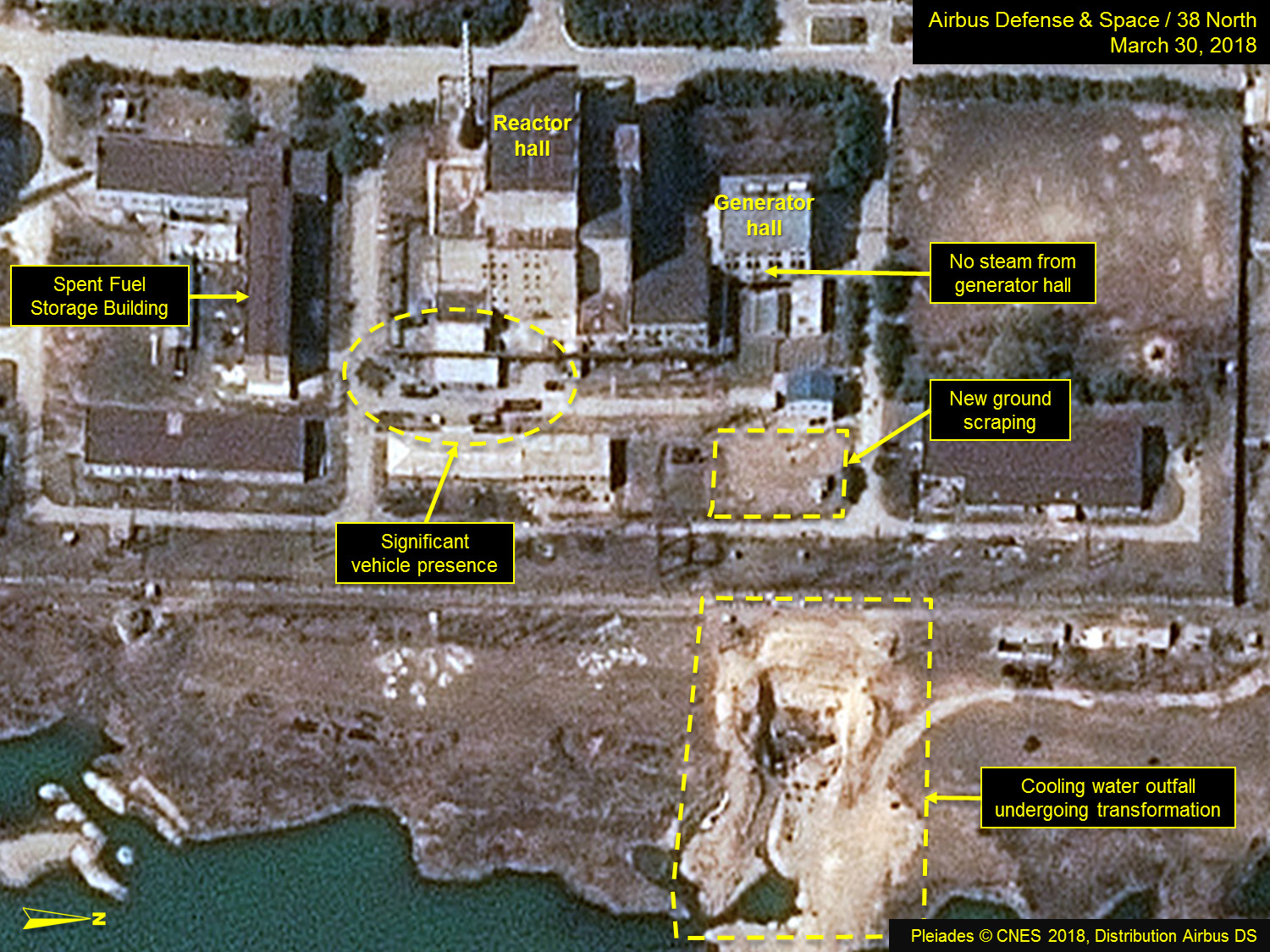
Yongbyon complex March 30, 2018

          Even as no official agreement was made, leader Kim Jong Un still gave notions of willingness in denuclearization. In response to a journalist asking about  denuclearization, Kim Jong Un stated, “If I’m not willing to do that, I won’t be here right now.” Mr. Trump stated after claiming, “That might be the best answer you’ve ever heard” and that “The relationship is as good as it’s ever been, I think better.” In light of no clear cut deal being made, progress has appeared to occur with Kim Jong Un offering to have a U.S communication office within North Korea and Mr. Trump agreeing “...it’s a good idea, both ways,”


          The overarching result with the summit has met with semi conflicting opinions from Japanese prime minister, Shinzo Abe, and South Korean president, Moon Jae-in. Japan’s prime minister stated that “I fully support Mr. Trump’s decision.” However, president Moon Jae-in found “It...regrettable that they could not reach a complete agreement” but however thinks “The prospects for a next meeting are bright given President Trump’s will to continue dialogue and his optimistic views.”

Reactions: While disappointing, relations and progression towards denuclearization appears to be in a better stance than before. With the consenting ideas of establishing a communications base of operations within North Korea, hopefully, more negotiations can easily be made now, therefore, causing more progress to occur. While no solid deal emerged out of the summit, I am glad at least some sort legitimate concrete steps were discussed, however, it’s only in the future to see if they are committed to it. If I was a resident in a nearby country in relation to North Korea, personally I would still feel quite threatened as nothing concrete actually happened, but still have just a bit of peace of mind for the future.

Connection: Overall, the entire premise of this screams The Cold War to me. From the talks of denuclearization, the entire premise of The Cold War, as well as the briefly mentioned potential discussion to the end of the Korean war all links back to it. In fact, simply the existence of a North and South Korea is caused by The Cold War due to the division along the 38th Parallel. Another similarity is if the mentioned communications facility is constructed, that could seem to be a parallel but weaker to the Moscow-Washington hotline established after the Cuban Missile Crisis. 

Questions:
Do you think a communications facility will actually be built in North Korea? If so, what effects do you predict it’ll have?

Do you agree more with Japan’s prime minister or Korea’s president or neither on the outcome of the summit?

How do you think countries close to North Korea in general feel about the outcome of this summit?


Thursday, February 28, 2019

Week 7: Kushner Met With Saudi Crown Prince to Push Mideast Peace Plan


See original article here: 


Summary:
President Trump's advisor, Jared Kushner, finally met with the Saudi king and crown prince since the murder of Jamal Khasoggi back in October 2018. For this meeting Kushner's intentions were to  explain his plan for peace between Israel and Palestine. Although it is said that Prince Muhammed ordered the killing of Jamal Khasoggi, Kushner and Prince Muhammad still have a strong relationship. At the meeting Kushner was there to ask Saudi Arabia for support with the administration peace plan. The Trump administration states that Saudi Arabia is an important ally and that it helps boost America's economy.


Prince Mohammed Bin Salman next to Jared Kushner and Ivanka Trump back in 2017


During the meeting it is said that Kushner, King Salman, and Prince Mohammed discussed peace efforts and American-Saudi cooperation with plans to improve conditions in the regions by investments. King Salman declared that his country "permanently stands by Palestine and it's people's right to an independent state with East Jerusalem as its capital." East Jerusalem is the main conflict between Israel and Palestine and for now Kushner does not know how his plan can solve this situation. 
  Image result for kushner and saudi prince meeting cnn

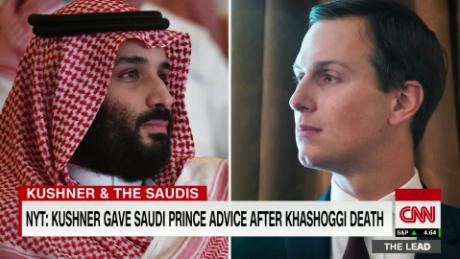
Kushner and Saudi Prince at the meeting


However, Kushner describes his plan as "very detailed, very in depth" and believes that it would "allow people to put the conflicts of the past behind them and to move forward and look forward to a really prosperous and exciting future." Analysts state that the plan involves investing $25 billion dollars in the West Bank and Gaza as well as tens of billion dollars in the region.


Reaction:
After reading the articles I think Kushner has the right idea about ending the strained tension between Israel and Palestine. However, the fact that the Trump administration and Kushner have stood by Prince Mohammed after he ordered the killing of Khashoggi has me a bit questionable about Kushner's actual intentions. In my opinion standing by a man who was behind a murder does not seem like the right approach to achieve a goal. But I do believe that the strained relation between Israel and Palestine does need to end because it has been going on for many years. I understand that finding an agreement that will suit both countries is very hard but if Kushner has a plan, both sides should try and listen to him. I think that the faster an agreement can be established the less tension there will be between countries.


Connection:
After a hundred years of off and on fighting, Israel and Palestine are still not at peace. Both countries have been fighting over the Gaza for decades which is known as the Arab-Israeli conflict. Because of this, the US is stepping in and is trying to find a way to end the tension between these two countries by creating a administration peace plan. There have been many attempts to try and end the fight between Israel and Palestine such as the UN Security Council Resolution 242 in 1967, Camp David Accords in 1978, Washington in 2010, etc. Both countries claim East Jerusalem as theirs which is the cause of this conflict. As we are learning about the Ara-Israeli Conflict in class right now, the meeting between Kushner and Mohammed Bin Salman just recently happened and they are trying to find a solution to end this fight.


Questions:
1. Should the US still have a close relationship with the Saudi crown prince even though he ordered the killing of Khashoggi?

2. Was the meeting between Kushner and Muhammad bin Salman affective? Will it change the relationship between the countries?

3. Do you think the Saudis will support the administration peace plan why or why not? If so what do you think the peace plan would look like?

Additional sources
source 1
source 2

Week 7 Pulwama attack: India will "completely isolate" Pakistan


Summary:

On February 14, 2019, Adil Dar part of a terrorist group called Jaish-e-Mohammad killed 46 paramilitary police in Pulwama, Indian -administered Kashmir by suicide bombing. Jaish-e-Mohammad mean army of Mohammad and is an Islamic extremist group form Pakistan. They want Kashmir to be part of Pakistan and have been around since 2000. The leader is Masood Azhar, who is well-known in the Middle East.


The Jaish-e-Mohammad flag

The suicide bomber (Adil Dar) was a high school dropout between the ages of 19- 21. He joined the group in 2018 and was ordered to do this task to show hatred against Kashmiri Muslims. Adil drove a bus filled with thousands of explosives into 78 buses carrying Indian paramilitary police. The bombing took place on the Srinagar- Jammu highway which is heavily guarded by Indian police.


Kashmir has been fought over for decades between India and Pakistan. Not until recently that they signed a treaty (Instrument of Accession) stating that Kashmir will split into two parts for both India and Pakistan. Kashmir has also been on the uprise for violent attacks in the last few years due to the attack in 2016 involving the killing of a 22 year old militant by Indian forces.


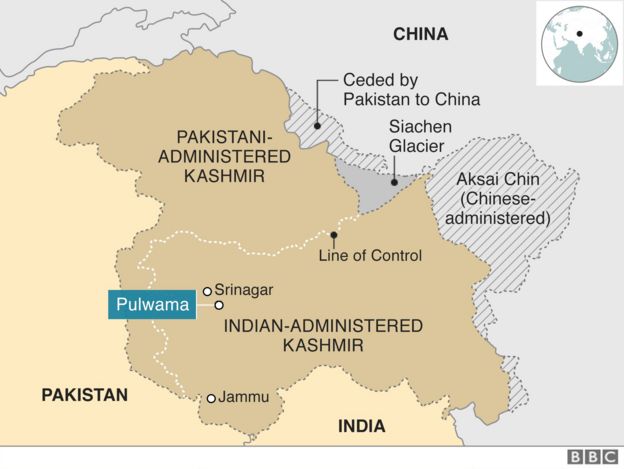
A map of  Kashmir divided into two sections which is bordered by Pakistan, India and China. The map also shows Pulwama, where the attack happened


This latest killing on paramilitary police was the worst terrorist attack in 30 years. In response, India will sanction Pakistan and asked the UN council to list the leader of Jaish-e-Mohammad, Masood Azhar as a terrorist. They will also remove Pakistan from the Most Favored Nation, a trading route between countries. This terrorist attack was the turning point for India to take initiative and "completely isolate" Pakistan.

Reaction:

This terrorist attack was terrible to read about and I think India is doing the right thing by isolating Pakistan. By doing this, it can help stop the rapid growth of Jaish-e-Mohammad and other terrorists group. Isolating Pakistan can also be a bad thing because it can anger the Pakistanis even more and maybe even cause another war between India. But as the attacks keep getting worse, India should take action as soon as possible before there is more bloodshed. I also think India and Pakistan should negotiate the land of Kashmir or recognize the borders of Kashmir to ease tensions. Overall, I think India needs to take initiative immediately and help prevent more attacks from Jaish-e-mohammad and other terrorist groups.

Connection:

This terrorist attack and the fighting for more land can relate to Nationalism from Modern World History. Jaish-e-Mohammad is on the uprising to take over Pakistan and Kashmir. This is an example of Nationalism because they don't necessarily want freedom, but they want to be heard and want to be recognized as a group of extremists who lead by fear. The conflict of India and Pakistan also relates to our unit about the Middle East. Pakistan is made up of mostly Muslims (Islam), which is the same as Kashmir. But India holds all different types of religions like Hinduism, Buddhism, Christianity and also Islam. There is a fight among the religions and the land of Pakistan and India which is similar to the main conflict of the Middle East. Overall, the terrorist attack in Pulwama is an example of both Nationalism and the conflicts within the Middle East.

Discussion Questions:
  1. Is India's reaction to the Pakistani terrorist attack reasonable?
  2. Can there be a compromise for the land of Kashmir to benefit both India and Pakistan?
  3. What else can India do to help stop more attacks from Jaish-e-Mohammad?

Additional sources:

https://www.theguardian.com/world/1999/sep/08/kashmir.india

https://www.globalsecurity.org/military/world/para/jem.htm

https://www.indiatoday.in/india/story/pulwama-attack-2019-everything-about-jammu-and-kashmir-terror-attack-on-crpf-by-terrorist-adil-ahmed-dar-jaish-e-mohammad-1457530-2019-02-16


WEEK 7: The US Cannot Crush Us, Says Huawei Founder

The US Cannot Crush Us, Says Huawei Founder


Background Information:
    Huawei is a Chinese multinational telecommunication equipment company. Founded by Ren Zhengfei, it is currently the world's third largest phone manufacturer (Behind Apple and Samsung). Despite Huawei's international success, the company's devices are extremely difficult to purchase in some markets, including the US.

    Over the past few years, Huawei has been providing Iraq and North Korea telecom equipment possibly capable of intensive spying on populations. These suspicions lead to the arrestment of the company's chief financial officer, Meng Wanzhou, who also happens to be Ren Zhengfei's daughter. Some government agencies believe that Huawei equipment contains backdoors that allow the Chinese government to snoop on customers. Recently, Huawei announced the new 5G wireless technology and hope to export this advancement globally.

Summary:
    Due to the security concerns of Huawei, the United States is currently attempting to ban all 5G services from leaking into the West. In Huawei's founder Ren Zhengfei's interview, he emphasizes that "Huawei will never accept anyone's instructions to install a backdoor." He also addresses the current condition of the company and states that "the US cannot crush [Huawei]." Ren believes that the absence of US market can only push Huawei forward. Currently, the U.S. is encouraging other countries to ban Huawei. By the end of 2018, Australia, New Zealand, and America completely restricted the selling of Huawei products. Other countries such as Canada and Germany proposed possible banning in the future. Despite the opposing factors, Ren states that they will continue to work with other countries such as the UK and expand international impact until Huawei becomes the largest telecom company.

Reaction:
   On a broader scale, the relationship with Huawei not only represent the willingness to cooperate with the company, but also the trust between two countries. It's shocking to me that America is putting so much effort into stopping Huawei from spreading. This also proves that America and China are competing to become the most powerful country in the world. As a Chinese citizen, I find it interesting how China manufactures a mass amount of products that are "untrustworthy," yet people are still using them. The rapid advancement of technology and new things are irresistible for citizens, and this eventually leads to the toxic market we currently have.

Connection:
    The trading of telecom products can be connected to the Belt and Road Initiative. The careful trading of Huawei products reflects the intense relationship and lack of trust between major countries. As products are transported across the globe, potential danger can emerge. As America proposed, China can use trading as an opportunity to spy on other countries. If China is actually able to gain secretive information from foreign countries, it might lead to a totalitarian world. Just like the Belt and Road Initiative, China will be able to control the decisions made by smaller countries.

Questions:
1. Do you think Huawei will be able to become the largest telecom company? Why or why not.

2. If Huawei technology really allows the Chinese government to spy on users, why are countries such as the UK willing to cooperate with the company?

3. Do you think this will impact the relationship between major countries? Why or why not.


Additional Sources:
Aljazeera.com
Businessinsider.com